105.2K
Downloads
48
Episodes
The Centre for Army Leadership’s “on the road” podcast series “Designed to Lead” seeks to showcase how the British Army deliberately develops leaders at key stages of a Soldier’s and Officer’s careers. Each episode will focus on a different part of their leadership journey, bringing in practitioners responsible for designing, delivering, and shaping leadership development through both formal training and education. If you’re early in your career, thinking about what comes next, or just want to understand how you’re being (or will be) deliberately developed as a leader, this series is for you!
Episodes
Aug 23, 2024
Aug 23, 2024
52 min
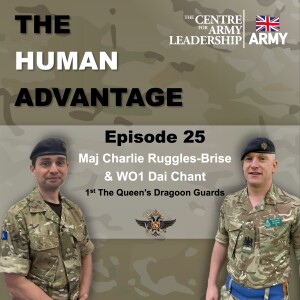
In this episode, our host Ash Bhardwaj speaks with Maj Charlie Ruggles-Brise and WO1 Dai Chant of 1st The Queen’s Dragoon Guards, “The Welsh Cavalry.” We explore the intricacies of leadership and development through the unique perspectives of two military professionals who have worked closely together since early on in their careers.
Charlie and Dai first crossed paths on Op HERRICK 9 in Afghanistan, when Dai was a junior vehicle commander and Charlie was a new Troop Leader. Their collaboration grew, eventually leading them to command A Squadron, with Charlie as Squadron Leader and Dai as Squadron Sergeant Major.
Dai highlights how developing individuals often happens "in the margins," where leaders adapt their styles to meet the unique needs of their team members. Charlie emphasises the importance of taking teams on the decision-making journey, noting how communication and transparency are vital to effective leadership.
This episode is unique in that it brings together perspectives from both the commissioned and non-commissioned career pathways, offering a comprehensive look at what it takes to lead effectively.
Join us as we explore how leadership is about more than just making decisions, it's about understanding your team, adapting in the margins, and leading with unity.
Jul 25, 2024
Jul 25, 2024
36 min
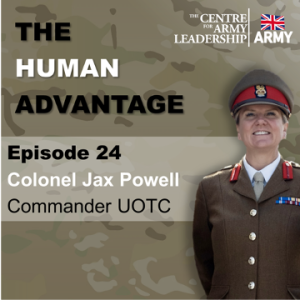
In this episode our host, Ash Bhardwaj, speaks to Colonel Jax Powell. Colonel Powell joined the Army in 1994, commissioning into the Royal Logistic Corps (RLC). She has served on operations in the Balkans, Iraq, Afghanistan and Mali. She has also held several Staff roles including stints at the Permanent Joint Headquarters (PJHQ), Army Headquarters, Home Command, and at the Development Concepts Doctrine Centre. Her junior career included a tenure as a Platoon Commander at the Royal Military Academy Sandhurst (RMAS) and, more recently, she has been an Officer Commanding (OC) of an RLC subunit on Op HERRICK in Afghanistan, and the Commanding Officer (CO) of 25 training regiment. Since joining the General Staff, Col Powell has been Deputy Commandant RMAS and Commander University Officer Training Corps (UOTC). Col Jax will be the next Corps Colonel for the RLC.
In this episode, we discuss ‘being scared of being scared’ on operations, and how being open about fearing fear is not something to be ashamed of. Col Jax also speaks ablut emotional intelligence and how different people have different requirements based on the context of a situation, and how understanding others emotions, as well as your own, in high-pressure situations is crucial to good leadership. She recognises the importance of kindness in leadership, yet balancing this with the necessity to remove emotion and be transactional when applying discipline.
May 10, 2024
May 10, 2024
31 min
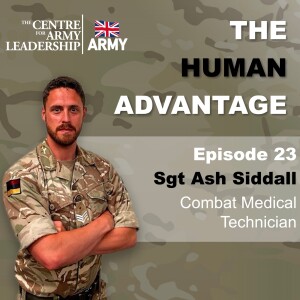
In this episode we speak to Sergeant Ashley Siddall of the Royal Army Medical Corps (RAMC). He began his career at the Army Foundation College Harrogate, at the age of 16, culminating in him joining the RAMC. After completing his trade training as a medic, providing pre-hospital care, Sgt Siddall joined 16 Medical Regiment, and has since deployed to Afghanistan on Op HERRICK 13, has served on Op OLYMPIC in London, and on operations in Somalia. He proceeded to complete the Black Serpent course to provide medical support in the joint service environment, before being attached to various combat regiments, including The Queen's Dragoon Guards (QDG) and 1st Battalion The Duke of Lancaster's Regiment (1LANCS), where he worked in their Regimental Aid Posts on operations, exercises and in barracks. Ash is now posted to 22 Multi Medical Regiment, as a Troop Sergeant to 32 (A) Squadron.
We discuss his leadership journey, and the significance reflection has played in allowing him to develop, and re-frame his approach to leading, as well as the negative impact that toxic leadership has on junior leaders finding their leadership style.
Apr 13, 2024
Apr 13, 2024
36 min
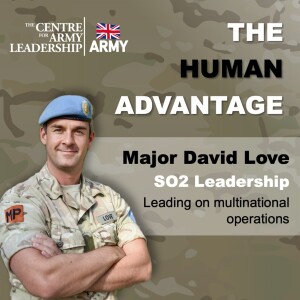
In this episode, we speak to Major David Love, Royal Military Police (RMP), in his role as SO2 Army Leadership at the Centre for Army Leadership (CAL).
We discuss how the CAL are developing the concepts and theory of leadership into tools that the Army can use. He focusses on the importance of understanding your people, and how by taking a human-centred approach to leadership enhances unit and team cohesion, as well as drawing upon the strengths of each individual to achieve greater operational outputs. We also discuss the role of unit identity and the importance of creating the feelings of belonging to forge a cohesive team. Underpinning all of this was understanding the role that empathy plays, firstly by reflecting on examples of where he had been led poorly and being able to evaluate that to shape how he would lead when he was given that responsibility.
Mar 22, 2024
Mar 22, 2024
38 min
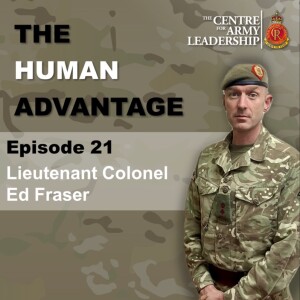
In this episode we speak to Lieutenant Colonel Ed Fraser of the Duke of Lancaster's Regiment, formerly the 1st Battalion The King's Regiment, which he commissioned into in 2001. He served in Afghanistan on Op HERRICK, and twice in Iraq on Op TELIC. Away from regimental duty, Lt Col Fraser instructed as a Platoon Commander at the Royal Military Academy Sandhurst, was a Staff Officer in the Army HQ Operational Training and Advisory Group and served as a Military Assistant to the Commanding General US Army Europe. He also led a Mission Support Team for the African Union Mission in Somalia on Op TANGHAM. He attended the Advanced Staff and Command Course at the Defence Academy before his tenure as Commanding Officer of the 4th Battalion The Duke of Lancaster's Regiment, which saw him oversee their contribution to Op INTERFLEX.
We discussed Lt Col Fraser's self-awareness of his leadership style and how it has developed over time, drawing on two particular examples from training prior to Platoon Command. He comments on competency, the ability to do your job from a technical perspective and knowing your your craft entirely, and the necessity of pairing it with human understanding - knowing your people and what makes them 'tick'. Lt Col Fraser recognises the significance of identity and creating a shared purpose, and references to the experience of creating sub-unit identities which aligned with the purpose of training Ukrainian soldiers, on Op INTERFLEX, to facilitate operational effectiveness across the whole team.
Mar 8, 2024
Mar 8, 2024
37 min
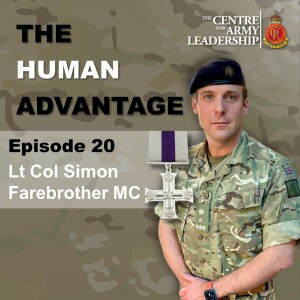
In this episode we speak with Lieutenant Colonel Simon Farebrother MC. Simon commissioned in 2001 into the Queen's Dragoon Guards (QDG) - a light cavalry regiment that specialises in reconnoissance. He served on operations on Op BANNER in Northern Ireland, on Op HERRICK in Afghanistan, and on Op TELIC in Iraq. His troop was attached to 3 Commando Brigade during the initial invasion of Iraq in 2003, for which Simon was awarded the Military Cross (MC) for gallantry.
Away from regimental duty, he was a Troop Leader at the Army Training Unit in Winchester. He later taught newly promoted Majors on the Intermediate Command and Staff Course (Land) at Shrivenham, before attending the Advanced Command and Staff Course himself. He later commanded the Army Foundation College at Harrogate throughout the COVID pandemic, and is now Deputy Chief of Staff at the Royal Military Academy Sandhurst (RMAS).
In this episode we learn how the partnership between officers and non-commissioned officers is vital to the Army's performance, and how the organisational culture we create as leaders determines the way people integrate and behave.
Feb 16, 2024
Feb 16, 2024
25 min
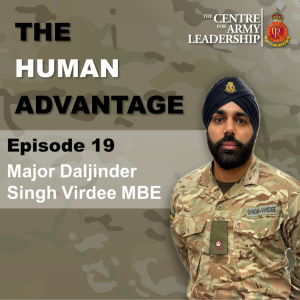
In this episode we speak to Major Daljinder Singh Virdee MBE. Major Virdee commissioned into the Royal Army Medical Corps in 2015 as a pharmacist Professionally Qualified Reserve Officer. Following regimental duty with 256 Field Hospital, he re-roled as a Medical Support Officer and went into full-time Reserve service (FTRS). He has since worked in staff roles at Headquarters Regional command, generating forces for deployments and policy and guidance to aid in community engagement and recruiting. Along the way, he developed engagement guides with certain British communities, and codified the dress code for Sikh soldiers.
This episode explores the power of staff work in cultural change and the challenges of teamwork and leadership in the policy environment. We also consider the opportunities for the learning of leadership in the British Army, which is otherwise omitted based on assumption of understanding in some civilian occupations.
Feb 9, 2024
Feb 9, 2024
27 min
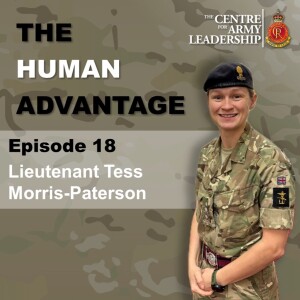
In this episode we speak to Doctor and CAL Senior Research Fellow, Lieutenant Tess Morris-Paterson PhD, about what we can learn from her experience in the selection, training, and preparation of astronauts for space flight, and how some of those skills can be applied in a military context to her experience as a Troop commander with 135 Geographic Squadron Royal Engineers.
Lt Morris-Paterson joined the Army Reserve in 2018 and completed trade training as a combat engineer before commissioning as an officer at the Royal Military Academy Sandhurst. In her civilian career, Tess has worked in elite and professional sport for twelve years, working with Olympic and Paralympic athletes, as well as those in the Premier League and Formula1. In 2019 she began working in Human space flight, culminating in a stint at NASA's Ames Research Centre. Tess obtains a PhD in aerospace physiology, and founded her own company, AstroPerform, which specialises in the selection and training of astronauts for space flight. She draws on her experience to highlight the importance of attacking difficult conversations, as soon as possible, and the significance of efficiently providing emotionally intelligent feedback at all levels.